What is best fuel plan for an ENDURANCE athlete?What is the ideal food plan for busy, ambitious, high performing athletes?? Aging athletes? Female athletes?
IT DEPENDS ON YOU!
Let’s dive into different articles on KETO for ENDURANCE Athletes…
In 1980, world renowned Keto researcher Stephen Phinney ran an interesting experiment.[*] He tested the endurance of 6 obese people (on a treadmill) under two different conditions:
A normal carb-containing diet
A protein-supplemented fast (a hypocaloric Ketogenic diet)
The results weren’t subtle. After six weeks of Keto-adapting, the participants could stay on the treadmill nearly twice as long before becoming exhausted!
Phinney followed this study with another in 1983, this time on cyclists. He found that, after four weeks of fat-adapting, the cyclists’ burned significantly more fat without any impairments in VO2 max.[*]
Since then, more evidence has emerged suggesting Keto is compatible with endurance training:
After two weeks of high-fat dieting, trained cyclists had improved time to exhaustion during moderate-intensity exercise[*]
Many ultra-endurance runners have been successful on a Keto diet—burning more body fat for energy during their long efforts[*]
Based on these studies, the main benefits of Keto-adaptation are increased fat burning and increased time to fatigue. This makes sense. The fat fuel tank is much bigger, so you can exert yourself for longer when Keto-fueled.
What about other markers of performance? The jury’s still out. For instance, one study on elite race walkers found that, although the walkers burned more fat on a low-carb diet, they required more oxygen to fuel the same amount of exercise—not a positive sign.[*]
Recovering from Exercise on Keto
Can you recover from exercise without carbing up? To answer, let’s examine two markers of recovery: lactate and glycogen.
#1: Lactate
During exercise, you form a compound called lactate (or lactic acid) as an alternate fuel source. After exercise, the extra lactate is cleared by the liver.
Harder and longer efforts, however, cause lactate to accumulate faster than it can be cleared. And the more lactate that accumulates, the more recovery is impaired.
Where does Keto come in? In one 2014 study, one month of Keto dieting raised the lactate threshold in cyclists.[*] In other words, they could clear lactate more efficiently at higher intensities.
In another study, endurance athletes in ketosis had lower lactate concentrations after exercise than carb-fed athletes. This suggests better recovery.[*]
#2: Glycogen
Keto-adapting doesn’t mean you use zero carbs for energy. Harder, longer exercise always demands some glucose. But in the Keto-adapted athlete, the balance shifts away from carbs and towards fat.
That’s where glycogen comes in. Glycogen, if you recall, is your body’s carb storage tank. The more glycogen is depleted during exercise, the more fatigue sets in.
By reducing the need for glucose, Keto may reduce the need for glycogen. This would allow the Keto-adapted athlete to preserve his carb tank and ward off fatigue.[*]
Keto For Endurance Exercise: The Bottom Line
Given sufficient Keto-adaptation time, fat can fuel endurance exercise just as well as a carbohydrate-fueled diet. Multiple studies show improvements in fat burning and time to exhaustion after folks adapt to Keto.
This doesn’t mean, however, that Keto enhances all aspects of endurance performance. Depending on what metric you look at, it might not.
To train for endurance on Keto, allow 4-6 weeks to Keto-adapt on a low-carb diet. This trains your body to burn more fat—and require fewer carbs—during exercise.
Finally, listen to your body. Not everyone feels their best when training on Keto, and you may want to bring back carbs. For specific strategies on carb cycling, exercise logging, and more, check out Carb Manager’s guide to exercise on Keto, as well as our deep dive on the Cyclical Ketogenic Diet. Thanks for reading, and happy training.
Are you a fat fueled athlete?
Are you a fat adapted athlete?
How You Fuel Endurance Exercise = To power muscle contraction during exercise, you need energy. This energy takes the form of a molecule called adenosine triphosphate, or ATP.
ATP is usable energy. To make ATP, your body (primarily) uses either:
Carbohydrate
Fat
The main determinant for which fuel gets used? The availability of carbs.
When carbs are available, your body preferentially uses carbs (glucose) to make ATP. When they’re not, you shift to using fat for energy.
Since carbs are scarce on the Keto diet, it triggers a shift to fat for fuel. This not only gets you burning more fat, it also unlocks a massive fuel reserve that was previously inaccessible.
Keto-Adaptation = Keto-adapting, also known as fat-adapting, refers to the shift from carbs to fat as a primary energy source. Based on the available evidence, Keto-adapting may take anywhere from 2 to 8 weeks, depending on your metabolism.[*]
Let’s talk about how endurance exercise is usually fueled. If you’re familiar with ultra-endurance efforts—marathons, long swims, Ironman, etc.—you know that, during these efforts, the athletes require continuous carb refueling.
Why? Because your body can only store a limited amount of carbs—about 500 grams as glycogen in muscle and liver cells. That’s only 2000 calories of energy.
Obviously, 2000 calories won’t get you through a marathon. That’s why ultra-endurance athletes drink that sugary goo. They need the extra energy.
But if the athlete is Keto-adapted, she can access a more abundant energy source: Body fat. Body fat contains about 20X the calories as glycogen, even in a lean person.[*]
To recap: The carb tank holds 2,000 calories, while the fat tank holds closer to 40,000. Being able to access the fat tank, it seems, lends a significant advantage.
But does this advantage translate to the real-world of endurance sports?
Coined by long-time Keto researcher Dr. Stephen Phinney, Keto-adaptation simply means adapting to using fat for energy.
The process of keto-adaptation, or fat-adaptation, typically takes several weeks of carb restriction on a Keto diet.[*] For most people, this means keeping carbs at around 5-10% of daily calories, filling in the rest with fat and protein.
Why must carbs be limited to fat-adapt? Because high intakes of carbohydrates raise blood sugar and insulin levels, and high circulating insulin prevents the breakdown of body fat. Insulin is a fat-storage (not a fat-burning) hormone.[*]
When you limit carbs, insulin levels fall. This tells your cells: Ah, carbs are scarce, we need to look elsewhere for energy!
That elsewhere is body fat. And when you can access body fat, it’s like hitting the energy jackpot.
That’s because you can store way more energy in fat cells (triglycerides) than you can in glycogen, your storage form of carbs. You can store a mere 2,000 calories in glycogen. But in fat, even a lean athlete has about 40,000 calories socked away.[*] That’s a difference of 20x!
Picture two endurance athletes. One must constantly refuel her carb tank. The other can access 40,000 additional calories of body fat. Advantage, Keto athlete.
We’ll dive into Keto endurance exercise in a later article, but for now, understand that fat can fuel longer efforts just fine. This is supported, in case you were wondering, by research on Keto-adapted ultra-endurance athletes.[*]
Do You Need Carbs for Exercise?
Many types of exercise—especially the harder, longer efforts—rely heavily on carbs for fuel. These exercises are known as glycolytic because they demand glucose.
For the non-keto-adapted person, eating carbs may help enhance performance during these exercises.
Does this mean you can’t perform these exercises optimally on Keto? Not necessarily.
But before experimenting with carbs, it’s wise to Keto-adapt for at least four weeks. Keto-adapting should help you fuel all types of exercise—not just the low-intensity exercise associated with the “fat-burning zone”.
In fact, there are many published examples of people performing better after adapting to Keto. For instance, in 1980 Dr. Stephen Phinney and colleagues famously showed that obese people—after several weeks of Keto dieting—could go for twice as long on the treadmill.[*] More recently, research has shown that Keto dieting plus resistance training is a good way to lose fat while maintaining muscle mass, and in some cases, even gain muscle mass.[*] To be clear, however, Keto is not the best diet for building large muscles.[*] You need higher carbs to build large muscles efficiently.
Note that studies showing good athletic performance on Keto gave participants 8 to 12 weeks to Keto-adapt. What does this mean for you? During your time of transition, you’ll want to moderate your training regimen.
Exercise While You Keto-Adapt
In the early stages of Keto dieting, your body will be used to running on carbs for energy. It takes time to train your cells to run on fat.
Once you Keto-adapt, you should be able to handle (and benefit from) high-intensity training like sprints, Crossfit, or other hard efforts. That’s because keto-adapted athletes can:
Burn more fat to fuel exercise
Preserve glycogen more efficiently, saving it up for glucose-demanding efforts[*]
But during the first four to eight weeks of Keto dieting, consider taking it easier than you normally would.
This doesn’t mean you should post up on the couch for two months. Just be mindful that harder exercise may place undue demands on your body.
With that in mind, here are three categories of exercise to ease you into Keto:
#1: LISS
LISS, or low intensity sustained state cardio, will form the bedrock of your exercise routine as you fat-adapt. Light jogging, cycling, swimming, hiking, and walking are all fair game.
A good rule of thumb for LISS? Give it about 50% of your max effort, or max heart rate. You should be able to comfortably sustain these activities for at least an hour.
#2: Easy Strength Training
To maintain strength while Keto-adapting, focus on high-rep low-weight resistance training. Bodyweight exercises like push-ups, planks, lunges, and squats are ideal.
Keeping it light helps you stay out of the anaerobic (glucose demanding) zone. But don’t worry, you can crank up the weight once you fat-adapt. Later in this series, you’ll learn all about building strength on Keto.
#3: Balance, Flexibility, and Stability Training
If you want to stay functionally fit into your later decades, strength and endurance alone won’t cut it. You also need to bring balance, flexibility, and stability into your regimen.
Yoga and pilates are great all-in-one options here. Again, stick to the easier classes for the first few weeks of Keto. Save the 100-degree power vinyasa class for after you fat-adapt.
Getting Started With Keto Exercise
Did this article cover everything about the Keto diet and exercise? Of course not.
But it should help you exercise smarter as you begin your Keto journey. Future articles in this series will cover the nuances of strength and endurance training on Keto, including how to modify your Keto diet to suit your specific situation.
For more on this topic—weight loss considerations, peak performance, adding carbs, tracking macros, and more—check out Carb Manager’s comprehensive guide to Keto exercise.
The Cyclical Keto Diet is a form of carb cycling, or Keto cycling. When you follow a CKD, you eat high carb 1-2 non-consecutive days per week. The other days, you eat a Standard Keto Diet (SKD).
The SKD is a very-low carb diet in which you eat approximately 55-75% of calories from fat, 20-30% from protein, and less than 10% from carbohydrates. Keeping carbs low suppresses the hormone insulin, and low insulin signals your liver to burn fat and produce ketones. This unique fat-burning state is called ketosis.[*]
On Cyclical Keto, you follow the SKD macros most of the week. But on 1-2 high-carb days, you invert them.
CKD Macros on High-Carb Days
55-75% carbs
20-30% protein
10% fat
If you eat a 2000 calorie diet, you’re consuming 300-400 grams of carbs on high-carb days. If you’re very active, that number can even be higher.
Notice that, while fat and carbs trade places, dietary protein remains constant. For maintaining muscle, healing wounds, creating immune cells, producing hormones, and structuring every tissue in your body—there is no substitute for protein.[*]
For producing energy (ATP), however, both carbs and fat are up to the task. When you carb cycle, you oscillate between these energy sources.
Potential Benefits of the Cyclical Keto Diet
The CKD is popular among athletes as a performance enhancer, but athletes aren’t the only group who may benefit from carb cycling. To be clear, there isn’t much research on Cyclical Keto, so the benefits are somewhat speculative.
#1: Exercise enhancement
Do carbs enhance exercise? It depends on the activity.
Longer, harder efforts like marathons, obstacle racing, and high-intensity interval training (HIIT) demand glucose for energy—and dietary glucose (carbohydrate) is in short supply on Standard Keto. On the SKD, the sugars to fuel these efforts come almost entirely from a storage form of glucose called glycogen.
But liver and muscle cells can only store about 500 grams (2000 calories) of glycogen combined.[*] That’s probably not enough glucose to sustain, say, a Tough Mudder.
That’s where Cyclical Keto comes in. The high-carb days refill glycogen stores, helping the athlete recover and prepare for the next exertion.
What about carb cycling for strength training? It’s not clear if it helps. For instance, a 2020 study in the Journal of Strength and Conditioning Research found that a Standard Keto Diet improved strength, testosterone levels, and body composition in resistance trained young men.[*]
To settle this question, someone needs to compare SKD to CKD, head to head, in the context of resistance training. Until then, it’s hard to say.
How to Get Started With The Cyclical Keto Diet
Follow these practical tips to get started with the CKD the right way:
Do standard Keto for a month first. This gives you time to fat-adapt, helping you return to ketosis faster after eating carbs.
Plan your carb forays. Pick a day or two per week to eat high carb and commit to it. The more you plan, the less willpower is required. You might also carb cycle on a daily basis, saving all your carbs for one meal, like dinner. This isn’t technically the CKD, but who’s keeping score? Do what works best for you.
Eat healthy carbs. Pick whole food carbs like fruits, sweet potatoes, and other starchy vegetables. Skip the packaged, refined carbs. If your gut is sensitive to fiber, white rice can be a good hypoallergenic option.
Manage your carbs. The Cyclical Keto Diet requires some irregular carb counting. Make this easy by cycling macro goals on specific days of the week with the Carb Manager app. Yes, we actually have that function. 🙂
What should you eat before a workout, during and after?
Are you matching your fueling to your training days? What about on your off days, active recovery and low intensity days?
Why is it Important to Eat After Working Out?
When you exercise, your muscles experience micro-tears, you lose fluids through sweat, and your body uses the glucose stored in your body for quick energy. (Yep, even if you’re Keto!) First, it uses the glucose that’s freely available in your bloodstream, and then it dips into the glycogen reserves stored in your muscles and liver.
After your workout, your body needs to:
replenish the glycogen stored in your muscles and liver
build and repair muscle tissue
replace fluids and electrolytes lost through sweat
Eating the right foods after exercise can help your body do these jobs more quickly and efficiently – helping you recover faster, limiting muscle soreness and fatigue, and keeping you performing at the top of your game.
When to Eat After a Workout
Your body’s ability to build and repair muscle is enhanced after a workout[*]. This is called the “anabolic window,” and experts used to think it only lasted 30–45 minutes after exercising. However, newer research is mixed, and some studies have shown that this window may last several hours.[*]
The bottom line is: most people don’t need to panic about eating as soon as they finish working out – but it is a good idea to try and have a meal within two hours.
You may want to try to eat sooner – within 30 minutes if possible – if:
You did a long cardio or endurance workout – research has shown that delaying consuming carbs more than two hours after a long cardio workout may result in reducing muscle glycogen synthesis by 45%.[*]
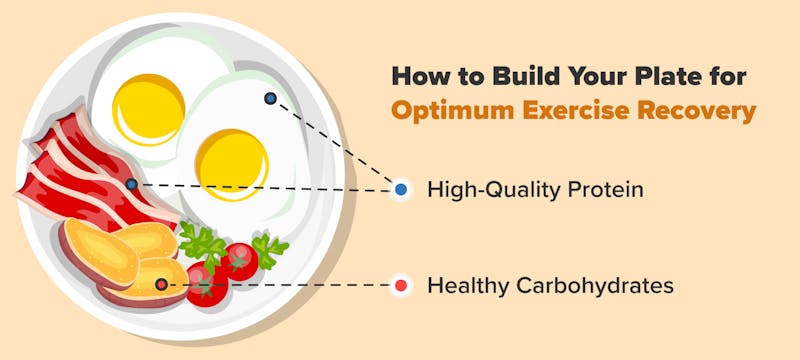
Your body needs a combination of all three macros to function at its best, but after working out it’s especially important to eat:
high-quality protein, to repair and build muscle
healthy carbohydrates, to replenish glycogen stores.[*]
How Much to Eat After Working Out
How much you need to eat will depend on how hard and how long you worked out, plus other lifestyle factors – your age, how often you exercise, and what your goals are (for example, if you’re trying to build muscle or lose weight).
Follow your hunger and be guided by how you feel. The best way to learn what works for you is to keep records of what you ate and how you felt – using the Carb Manager Daily Log will help you figure out what’s working and what’s not.
Post-Workout Macros
Protein
When you exercise, you experience micro-tears in your muscles. Your body uses the amino acids in the protein you eat after a workout to repair these tears and to build new muscle – a process called muscle protein synthesis.[*][*] An amino acid called leucine is especially important for muscle building and repair.[*]
Experts recommend consuming 0.25g of protein per kg of body weight (or 10 to 20 grams) after a workout to maximize muscle-protein synthesis.[*]
Carbs
Consuming carbs after exercise helps replenish your body’s glycogen stores, which become depleted during workouts. You’ll need more carbs if you’ve done a long endurance workout, exercise daily or more than once in a day.
Experts recommend consuming 1.1–1.5g of carbohydrates per kg of body weight.[*] But studies have also shown that a high-protein, low-carbohydrate diet can promote better muscle protein synthesis than a traditional, higher-carb diet – so don’t panic if you’re Keto.[*]
But even if you’re eating Keto or low-carb, make sure you have some carbs with your post-workout meal, as eating carbs and protein together has been shown to maximize muscle-protein and glycogen synthesis.[*][*]
Fats
How much fat you need will depend on your diet and goals.
Fat slows down how fast your body is able to absorb the nutrients in a meal, but studies have shown that adding more fat to a meal doesn’t affect muscle glycogen synthesis[*] and may even promote more muscle growth after a workout than a lower fat meal.[*]
What to Eat After a Workout
Here are some quick and easy ideas for post-workout snacks and meals. Check out our recipe database for thousands more ideas. If you’re a premium member, you can search our members’ database to find recipes with the specific calories and macros you want to consume.
When we say you need some carbs to replenish your glycogen stores, we don’t mean sugar or refined carbs like cookies, cakes or white bread. These will spike your blood sugar and leave you feeling terrible. You might not feel like digesting a heavy meal but stick to carbs that will digest slower and provide your body stable energy – like vegetables, berries, or whole grains if you eat them.
Make sure your meal contains a source of fat to slow down your digestion, help you absorb fat-soluble vitamins, and provide long-lasting energy – but stay away from fried foods and vegetable oils, which can cause inflammation.[*][*]
Keeping Hydrated
Depending on the type of exercise you’re doing, your body can sweat out between 0.5 and 2 liters of fluid an hour. This fluid is made up of water and essential minerals like sodium, potassium and calcium (known as “electrolytes”).
It’s important to replace both the water and the electrolytes after your workout to keep you from getting dehydrated, which can cause headaches, poor recovery, and muscle cramps.
The American College of Sports Medicine also recommends[*]:
drinking about 17 ounces (500ml) of water about 2 hours before you work out
drinking regularly throughout your workout – water is fine if you’re exercising for less than an hour. If your workout is longer than 60 minutes, you could choose to use an electrolyte or sports drink instead – go for a low sugar version if possible.
The Bottom Line
As a general rule of thumb, experts recommend consuming 10 to 20 grams of protein and a source of healthy carbohydrates within two hours of working out.
Try to eat sooner if you fasted before your workout or were resistance training, and increase your carbs to replenish your glycogen stores if you did a long endurance workout or work out every day or more than once in a day.
Don’t forget to stay hydrated by drinking plenty of water during and after your workout.
Is a Carnivore Diet or Animal Based Diet best for you?
https://wildlumens.com/11-benefits-of-a-carnivore-diet-9-will-surprise-you/Talk on the Street
Carnivore Diet proponent and author of “The Carnivore Diet”, Dr. Shawn Baker responds in his book when asked, “how do athletes perform on a carnivore diet?” by saying, “they appear to flourish!”
Dr. Shawn Baker himself is a world-class athlete and has been on a carnivore diet for about 3 years now, (at the time of writing this article.) We should also note he doesn’t use protein powder We should also note he doesn’t use protein powder
He says his athletic performance has improved significantly as he has been able to set three indoor rowing masters world records and six American records all the while on a carnivore diet.
Ever since the carnivore diet made a splash in the mainstream he has been consulting top tier athletes in various sports. The athletes have reported positives in the following:
Overall Performance
Improved Recovery
Faster healing from injuries (unlike injury-prone vegans.)
Dr. Baker does mention though that athletes will most likely see a drop in performance during the transition or adaptation phase of the diet which is very similar to the keto flu.
Dr. Baker goes on to mention that each athlete is different and during adaptation they may experience different levels of athletic depletion due to a few factors like under-eating or the type of sport they are in.
Some only need a week or two to adjust while others it could take months.
Dr. Baker says, “…a person coming from a high carbohydrate diet who engages in a highly glycolytically demanding sport such as Crossfit may take longer to adapt. A person who was previously on a ketogenic diet and competes in powerlifting might have an easier transition.”
Adaptation is key and the carnivore flu is no joke
Don’t you need carbohydrates to be an endurance athlete? What about glycogen storage? Muscle mass and strength? We surely need carbs for that, right? Actually it appears not so much!
Both endurance and strength athletes have been thriving on an all-meat diet and we are talking about athletes that partake in ultra marathons, Crossfit, MMA, rugby, rowing, powerlifting, football, basketball, and weightlifting…just to mention a few.
The Carnivore Diet comes with many potential benefits not just performance based as outlined in:
What is your fuel source being used for your workout? PNOE Metabolism Testing provides a precise way to determine heart rate zones based on an athlete’s metabolic response, utilizing VO2
Are you really doing HIIT or SIT? What are your ZONES? Going from Intensity Zones to Heart Rate Zones Exercise intensity zones are determined by the body’s metabolic response at
CHRONIC STRESS Solutions: Balancing your Minerals BEAM Minerals and Mineral Balancing for HPA Dysfunction, Adrenal Exhaustion, and Cortisol Dysregulation HPA axis dysfunction (often referred to as “adrenal exhaustion”) is typically
Are you struggling to get your vibrant self back again!? Test and not guess if you have HPA Axis DYS-Function and IM-Balance… do you have high or low cortisol –
Blood Flow Restriction (BFR) Training – Benefits and Mechanisms of Action Blood Flow Restriction (BFR) training, such as with BStrong bands, involves restricting venous blood flow while maintaining arterial inflow
Scroll to Top
🗓 Free Live Masterclass
Stop Guessing. Start Thriving in Midlife.
Join Coach Debbie Potts for a free 45-minute live session on rebuilding your metabolism, restoring energy, and preserving lean muscle — no matter your age.
📅 Monthly Live Sessions — Pick Your Date·⏰ 4:00 PM PST·💻 Live on Zoom